
Looking away
Reminders from Tsim Sha Tsui

On one of my trips to Hong Kong with Arup, I had a weekend in between. I got on the magnificent MTR underground and headed down from Sha Tin to Tsim Sha Tsui and looked over Victoria Harbour to Hong Kong Island. (TST is on the Kowloon side) I went into a hall and heard the sound of violin music. There was a concert being played by a quartet with a smattering of people on the stairs sitting down and listening. At the front of the stairs were a bunch of elderly men possible grandfathers listening away. Suddenly some young teenage boy got up and started to walk across in front of them and there were raised voices in Cantonese and the boy blushed and sat down immediately.

At the time I wondered what would have happened in an English town if the same had happened. Probably a lot of swearing at the old men with possibly the threat of violence.
There was a very good article by Mary Wakefield this weekend which reminded me of the event above and the differences, and how now we have learnt to turn our eyes away
In summary her article in the Spectator shares a deeply personal journey into the habit of “unseeing” — a defensive behaviour the author adopted after a frightening run-in with a teenage moped rider years ago. Rather than confront threats or antisocial behaviour, she describes how she and many others in London (and probalby all our cities and towns) now deliberately look away to protect themselves and their families, teaching even their children to do the same.
Mary’s article draws a parallel to China Miéville’s novel, The City and the City, where inhabitants of distinct worlds occupy the same space but learn to completely ignore one another. This “London version of unseeing” means averting your gaze from violence, theft, or intimidation on the streets and in shops, accepting that neither security staff nor police are likely to intervene.
She highlights a recent incident
“In the opticians recently, as my son and I waited for his glasses, a man rushed in, smashed the glass case surrounding the designer frames, scooped the lot and ran out. The in-store security guard explained to us, as he swept up the glass, that he’d been told not ever to intervene. The police never come, he said, and the shop has insurance so why risk your life? Why bother? We nodded. Why bother?”
Vivid anecdotes illustrate the extent to which citizens have normalised not getting involved, from ignoring knife-carrying youths and shoplifters to quietly leaving chaotic scenes untouched.
However, the piece turns with the recent Huntingdon train stabbings, where ordinary bystanders courageously intervened.
This sparks a questioning of the morality of chronic disengagement: if the next generation is taught only to look away, who will stand up when others are in danger? In a city where violent crime keeps appearing despite official reassurances, the author concludes that “unseeing” can no longer be the default — society cannot simply rely on institutions for protection or justice.
I suspect that most of us are now so inured to this that we too have started to look away because of fear for ourselves but also uncertainty that our fellow citizens will help but also that the state will not take action or even imprison those people and so we shrug our shoulders and say like that security guard “Why bother’
I thought about this today on Remembrance Sunday and hearing about the young men in both world Wars and in subsequent ones who fought and died for this country.
In recent days there was an interview with a veteran of 100 years old Alec Penstone on morning TV where he questioned had his effort been worthwhile
Alec emotionally described seeing “rows and rows of white stones” in his mind’s eye — the lost comrades — and paid tribute to all who gave their lives.
He was candid and sorrowful, saying, “The sacrifice wasn’t worth the result that it is now.” He explained, “What we fought for was our freedom. We find that even now is downside worse than what it was when I fought for it.” He expressed a deep sense of disappointment in how the country has changed, feeling that the freedoms and values for which his generation fought have deteriorated.
But in the end Alec stressed gratitude and the importance of continuing the fight to uphold the country they defended, encouraging younger people to honour what was sacrificed and to strive to make Britain better. There was in it a heartfelt challenge to future generations to live up to the sacrifices of those who have served and died, but also those who serve and may die in future conflicts.

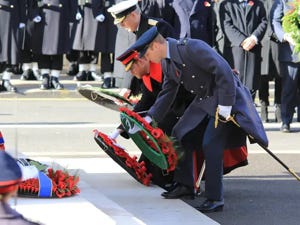
But in it was a unanswered question to those of us who have not served in the forces, but look away. Mary Wakefields article suggests that we have in the UK that those values and freedoms that Alec and his generation fought for we as citizens have slowly let deteriorate through neglect and fear.
I hope that when the moment comes for me that I wont look away but that also my fellow citizens do not and help people who need assistance when it is needed.
And yet - I take heart from the Remembrance service I attended yesterday, albeit in my small town of 13K residents. I saw lines of little children from local schools, large numbers of families with small children, teenagers sombrely lowering the flag; the guides, brownies, beavers, scouts et al. marching in time - and everyone held the silence. Not a single chatter and as we walked back I overheard fathers, in particular, explaining this sad occasion, talking about their family members from older generations.
I only wish we could all bring these memories to better manage the sorrows of today's world.
In some ways, of course, plus ca change. I well remember seeing handfuls of Mods and handfuls of Rockers having a small and noisy scuffle on the beach at Deal on the Kent coast one sunny afternoon. Not exciting enough to make any headlines
https://www.bbc.co.uk/culture/article/20140515-when-two-tribes-went-to-war
On crime more generally - I read Sadiq Khan on this re London: https://www.bbc.co.uk/news/articles/cn5qg3yn15wo
On shoplifting and how our society is handling this - that's a different matter - and all generations are at fault.